Summary: Contractors ordering concrete pipes Durban and across KwaZulu-Natal should lock in the pipe schedule, confirm production and dispatch dates, and prepare the site for offloading well before the year-end shutdown. Pipes that arrive late, in the wrong load class or with the wrong joint type can stall trenching and leave excavations open over the holiday period.
Finalising the order early gives your team time to resolve discrepancies and receive the correct pipes before the site closes.
How Can Contractors Secure Concrete Pipes in Durban Before the Holidays?
The excavator is booked. The trench is open. Then someone asks whether the 600mm pipes have actually been confirmed for dispatch.
Late in the year, a small procurement gap becomes a programme problem. A trench left waiting for pipes over the break is a safety, stormwater and cost risk, and there are fewer opportunities to correct an order once supplier schedules and transport tighten.
Answer: To secure concrete pipes in Durban before year-end, finalise an approved pipe schedule (diameter, SANS 677 load class, joint type and quantity per run), confirm production and dispatch dates in writing with your concrete pipe supplier in KZN, and agree delivery, offloading and on-site storage before the order is placed.
Cobro Concrete manufactures SABS-approved concrete pipes complying with SANS 677, from 300mm to 1500mm diameter, in spigot-and-socket and inserted-joint configurations. See our SANS 677 concrete pipe sizes for diameters, load classes and masses. Pipes are produced at Cobro’s Cato Ridge plant, and transport can be arranged to sites anywhere in South Africa.
Get the Pipe Schedule Right, Then Protect the Delivery Date
Pre-holiday procurement works best when technical approval, supplier coordination and site preparation happen together.
1. Replace Rough Quantities with an Approved Pipe Schedule
“About forty pipes for the stormwater line” leaves too much room for interpretation.
Build the schedule from the latest approved drawings and list, for each run:
- Nominal internal diameter (for example 450mm, 600mm or 900mm).
- The SANS 677 load class specified by the engineer (for example 50D, 75D or 100D).
- Joint type: spigot-and-socket or inserted joint.
- Number of pipes, calculated from the run length and the supplier’s effective laying length per pipe.
- Connecting manhole shaft sections or culverts that belong on the same delivery programme.
Load class is set by the design (cover depth, bedding, trench conditions and traffic loading), not by what is available in the yard. If the specified class cannot be supplied in time, refer it back to the engineer rather than substituting. For more on the standards themselves, see why SABS-approved concrete pipes matter in public stormwater infrastructure.
2. Ask Your Concrete Pipe Supplier for Specific Commitments
A quotation is a starting point. You still need to know whether the specified pipes will be ready, and on site, when the crew needs them.
Ask your concrete pipe supplier in KZN to confirm:
- Stock availability for each diameter and load class.
- Production and curing time for pipes cast to order.
- Order acceptance, deposit and payment requirements.
- The last dispatch date before the year-end closure, and the first dispatch date after reopening.
- Whether transport to site is included, the vehicle type, and who is responsible for offloading.
Confirm the supplier’s actual holiday schedule directly rather than assuming. If diameters or quantities change, request an updated dispatch date in writing. If you are still choosing a supplier, start with our guide to vetting your precast supplier for quality..
3. Make Sure the Site Is Ready to Receive the Pipes
Large-diameter concrete pipes are heavy. An early delivery only helps if the site can offload, inspect and store them safely.
- Confirm truck access and turning space to the laydown area.
- Have suitable lifting equipment and a competent operator on site at the agreed delivery time.
- Store pipes on firm, level ground, chocked against rolling, and stack only as the supplier’s instructions allow.
- Protect spigots and sockets from soil and impact damage while pipes wait to be laid.
- Check diameters, product markings and quantities against the delivery note, and record chips, cracks or socket damage before signing.
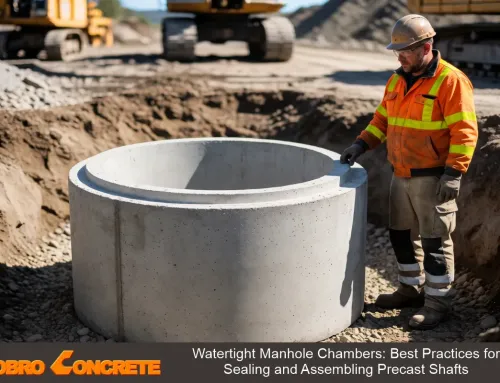
Leave a working buffer between delivery and laying. A final-afternoon delivery leaves no time to correct a short or damaged load. Once pipes and shaft sections are on site, our guide to sealing and assembling precast manhole shafts covers the jointing stage.
What Should Be Confirmed Before the Purchase Order Goes Out?
Use the following checks to turn an urgent enquiry into a clear procurement brief.
| Before You Order | What To Have In Writing | What It Save You In December |
|---|---|---|
| Approved pipe schedule | Diameter, SANS 677 class, joint type and quantity per run, referenced to current drawings. | Prevents wrong-class or wrong-joint deliveries. |
| Linked components | Manhole shaft sections and culverts on the same programme scheduled together. | One coordinated delivery plan instead of several. |
| Compliance documentation | SABS mark and supporting test documentation for the pipes supplied. | Supports engineer and municipal acceptance. |
| Confirmed dates | Order cut-off, last dispatch before closure and delivery responsibility agreed in writing. | Keeps trenching and laying on programme. |
| Site readiness | Access, lifting equipment, laydown area and inspection on receipt. | Avoids rejected or damaged loads. |
Frequently Asked Questions
How early should I order concrete pipes before the holidays?
Work backwards from your laying date, allowing for confirmed production and curing time, transport, inspection on receipt and a buffer for corrections. There is no universal cut-off date; obtain the supplier’s current dispatch schedule for your specific order.
Can a different pipe class be used if the specified one is unavailable?
Only with the responsible engineer’s approval. A lower class may not carry the design loads, and even a higher class should be confirmed against the design before it is installed.
Does Cobro deliver concrete pipes to sites outside Durban?
Yes. Cobro manufactures at Cato Ridge, serves projects across KwaZulu-Natal and neighbouring provinces, and offers transport anywhere in South Africa. Confirm delivery arrangements for your site when you request a quote.
Get Your Year-End Pipe Order Confirmed with Cobro Concrete
Cobro Concrete manufactures SABS-approved concrete pipes (SANS 677, 300mm to 1500mm), manhole shaft sections (SANS 1294, 750mm to 1500mm) and rectangular culverts (SANS 986, 600mm to 3000mm), serving projects in Durban, across KwaZulu-Natal and neighbouring provinces.
Send your approved pipe schedule, site location and required delivery dates to Cobro’s sales team to confirm stock, production and dispatch before the year-end closure.
- Request a Quote: Contact Cobro’s Sales Team
- View the Range: Cobro’s Precast Concrete Products
- Read Next: Why SABS Approved Concrete Pipes Matter in Public Stormwater Infrastructure